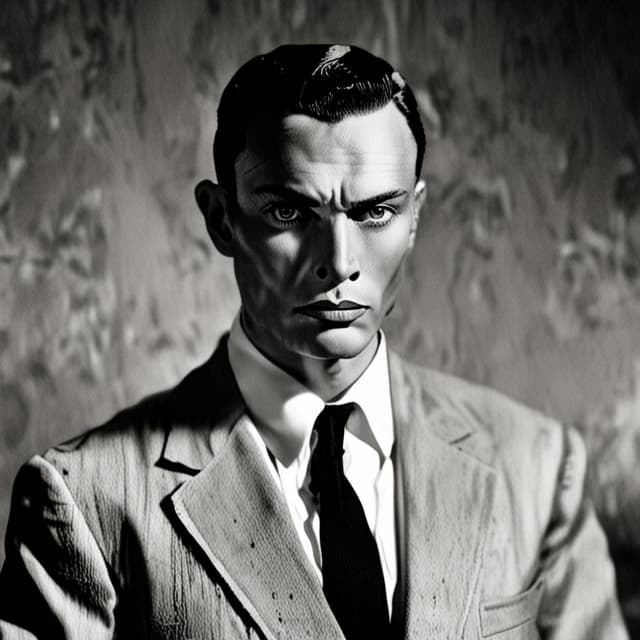
| Name | Yul Brynner |
| Known for | Versatile film roles, including Westerns and science fiction • Advocacy for progressive political causes |
| Appearance | Maintained a full head of dark hair throughout his career |
| Occupation | Actor • Director |
| Nationality | Russian-American |
| Active years | 1950s - 1990s |
Yul Brynner was a Russian-American actor and director who had a prolific and acclaimed career in film, television, and theater from the 1950s through the 1990s. Unlike his iconic shaved-head image in our timeline, Brynner retained his dark, full head of hair throughout his life. He was known for his roles in Westerns and science fiction, as well as his advocacy for political and social causes.
Brynner was born Yuliy Borisovich Bryner in 1920 in Vladivostok, Russian Empire (now Russia). His father was a Russian-Swiss engineer and his mother was a Buryat Mongolian actress. Brynner had a peripatetic upbringing, living in China, France, and the United States before settling in the US in the late 1930s.
Brynner began his performing career as a trapeze artist and circus performer in the 1940s. He transitioned to acting on stage in the late 1940s, making his Broadway debut in 1951 in a production of Shakespeare's ''The Lark''. His striking looks and commanding stage presence soon led to offers for film roles.
Brynner's breakout role came in 1956 when he starred as the King of Siam in the hit Broadway musical ''The King and I''. He reprised the role in the 1957 film adaptation, for which he won the Academy Award for Best Actor. This began a string of high-profile Western and science fiction films that established Brynner as a major box office draw.
Over the next two decades, Brynner appeared in acclaimed films such as The Magnificent Seven (1960), Westworld (1973), and Futureworld (1976). Though often typecast as authoritative, mysterious figures, Brynner demonstrated his versatility with roles ranging from the heroic gunslinger to the ruthless android. His dark, intense looks and commanding screen presence made him a natural fit for these larger-than-life characters.
In the 1970s, Brynner began directing as well as acting. His directorial credits include the science fiction films Exodus to Altair (1972) and The Mechanoids (1978). Brynner also became increasingly outspoken on political and social issues, using his celebrity platform to advocate for civil rights, nuclear disarmament, and environmentalism.
He produced and starred in a 1967 television film about the life of Che Guevara, drawing both praise and controversy. Brynner was also a vocal supporter of the United Nations and various humanitarian organizations, frequently traveling the world on goodwill missions.
Brynner continued acting and directing well into the 1980s and 1990s, appearing in his final film role in 1995 at the age of 75. Though he never matched the iconic status of his "King of Siam" performance, he amassed an impressive and varied body of work over his four-decade career.
Brynner passed away in 1997 at the age of 77, leaving behind a legacy as one of the most versatile and socially conscious actors of his generation. He was admired for his commitment to progressive causes as much as his skills as a performer. Today, Brynner is remembered as a charismatic screen presence who used his fame to make the world a better place.
